

By Sebastian Carneiro, CEO & Co-Founder, and David Solomon, Investment Analyst.
The energy transition is widely assumed to require replacing today’s vast fossil fuel inputs with an equivalent volume of renewable generation — a costly, capital-intensive undertaking that critics argue is unrealistic at scale. This assumption rests on a comparison of primary energy inputs, what Canadian energy analyst Paul Martin and others call the Primary Energy Fallacy: conflating raw energy inputs with the useful services people actually consume, while ignoring the large conversion losses inherent in today’s combustion-heavy system.
Once these losses are accounted for, the picture changes materially. Electrification and energy efficiency deliver the same services — heat, mobility, light — using far less input energy, and a fully electrified global energy system could cut final energy demand by 40%, avoiding a proportionate share of the renewable capacity, storage and grid infrastructure otherwise required (see chart below).
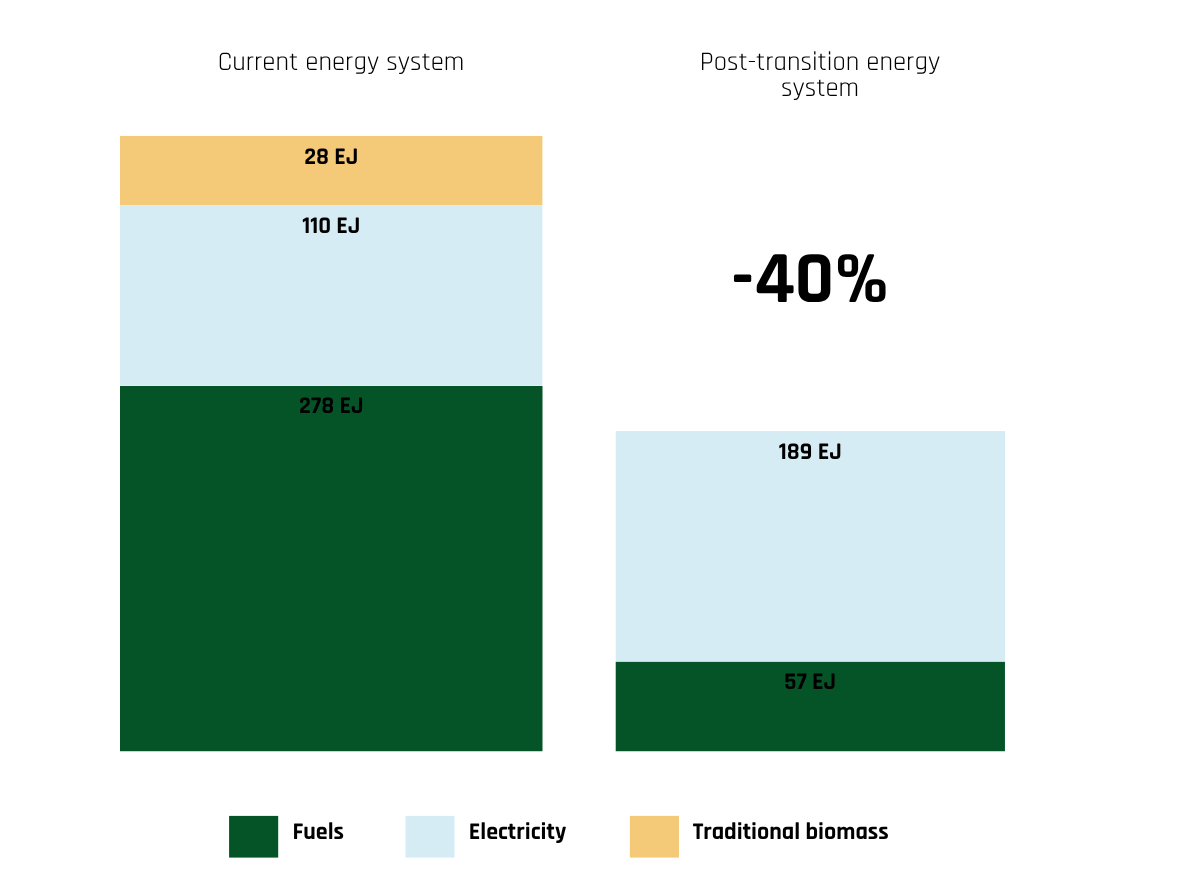
Source: Graphic by Hannah Ritchie using data from Nick Eyre (2021)
Solas Capital’s own white paper series has repeatedly emphasised “the power of less”, showing that reducing demand via efficiency and shifting to efficient electric end-uses shrink the cost- and time- problem the energy system must solve to accomplish a successful energy transition. That is the same logic at the heart of the primary energy critique.
What primary energy is and why it misleads
Primary energy is an accounting construct. It adds up the energy content of fuels and non-combustible sources before any conversion through human-engineered processes takes place. People, however, do not gain any benefit from energy in its natural ‘raw’ form but instead purchase energy in its ‘final’ form; when it has been transformed to a useful energy service.
The energy chain describes the transformation of energy from its original form to useful services through four stages:
- Primary energy is energy in its natural state before any conversion: crude oil in the ground, coal in a mine, sunlight hitting the earth, wind, natural gas, or uranium ore.
- Secondary energy is obtained after converting or processing primary sources: gasoline refined from crude oil, or electricity generated from coal or solar panels.
- Final energy is what is delivered to the end user: electricity at the wall socket, gasoline at the pump, or natural gas piped into homes.
- Useful energy is the actual service provided: light from a bulb, motion of a car, heat warming a room, or cold air from a refrigerator.
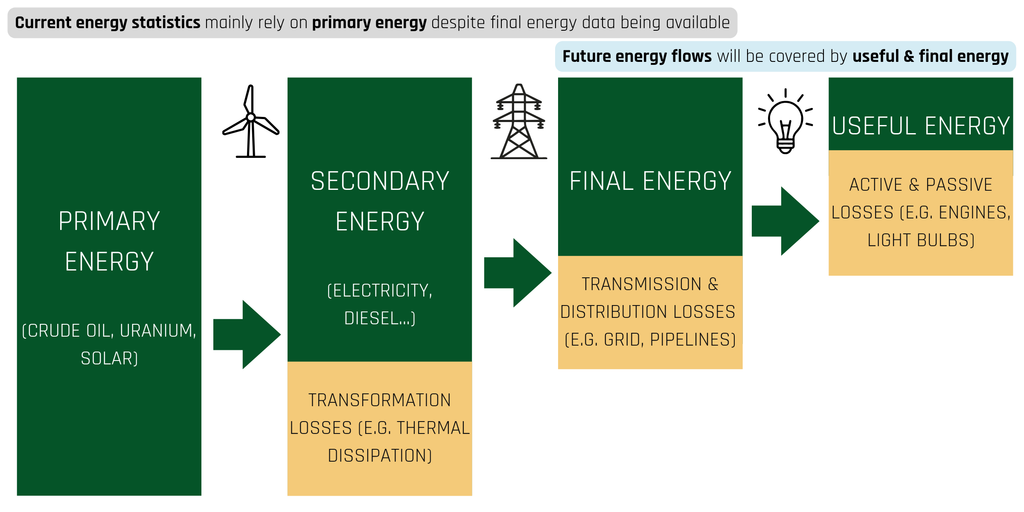
At each conversion stage, energy losses occur, predominantly as waste heat. These losses accumulate and are disproportionately large in today’s combustion-heavy system. In typical thermal power, up to two-thirds of the energy in coal or gas is dissipated as heat before a single kilowatt-hour is delivered to the end user. Consequently, fossil fuels appear large in the primary energy context even when they, in fact, deliver the same service as an efficient electric alternative.
Our paper explains the Primary Energy Fallacy, quantifies the efficiency advantage through EV, heat pump and power generation examples, and sets out the macroeconomic and investment case for allocating to the demand side of the energy transition.